E-commerce seller: AI closed 3,800 inquiries with no reps
A custom-canvas-portrait store, 9 years in business, with 90% of inbound traffic coming through online marketplaces. We deployed an AI sales agent with 20 tools and a mile-long prompt. In 6 weeks: first reply dropped from 20–30 minutes to 20–30 seconds, direct conversion to paid hit 10% with zero human involvement, and total conversion climbed to 25% vs. 14% before.
4 leak points where the store was losing sales
The marketplace sends leads around the clock, but a human team works in shifts. Between those two rhythms, inquiries and revenue kept walking to competitors.
4 reps stretched past their limit
- couldn't keep up at peak hours
- wrote dry, robotic replies by end of shift
- let first-reply time creep to 20–30 minutes
- slowed down exactly when speed mattered most
Low conversion from weak follow-up
- at "let me think about it," the rep politely signed off
- there was no systematic follow-up sequence
- objection handling ran on gut feel, different for each rep
- some buyers left saying "I'll be back" and never were
Overnight and weekend traffic wasted
- dozens of messages from evening to morning
- by sunrise, half had already bought elsewhere
- to avoid burning ad spend overnight, they had to pause campaigns
- in peak season (December — the gift-portrait rush) losses multiplied
Reps weren't keeping the CRM
- contacts weren't captured systematically
- pipeline stages were set by hand "whenever I remember"
- after a couple of manager reminders, old habits crept back
- repeat follow-up and reactivation are impossible without clean data
This is not a button-tree chatbot — it's a virtual sales rep
The difference is fundamental. Old bots with button trees and canned replies annoy buyers and don't sell. An AI sales agent holds a real text conversation: it reads context, asks follow-up questions, works objections and closes the sale.
Button flows, FAQs and canned replies
- Rigid button tree — the buyer can't "go off-script"
- Any off-pattern question breaks the flow
- Reads no emotion, clears no objections
- Feels like a "robot" — buyers abandon the chat
- Fine for FAQ auto-replies, useless for selling
Real conversation, empathy and a close to paid
- Free-flowing text conversation — no buttons, no branches
- Adapts to context: the occasion, the use case, the budget
- Asks follow-up questions to surface the real objection
- Knows the catalog, pricing, shipping, warranty — never freezes on specifics
- Closes on a reservation, deposit or order with no handoff to a human
20 tools + a mile-long prompt
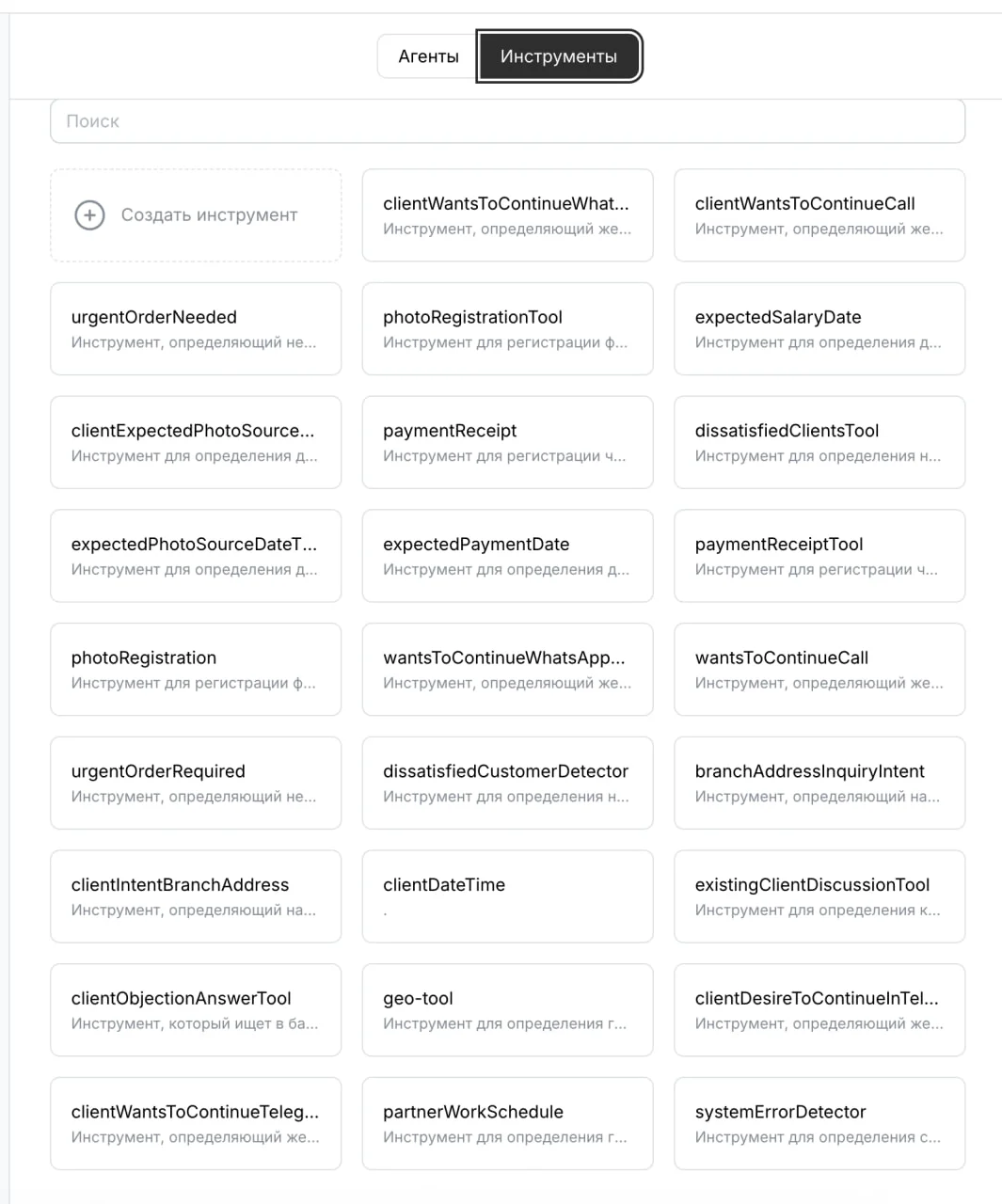
For this store we built 20 specialized tools — each one owns a single concrete job in the sale. Plus a detailed prompt that spells out roles, rules, objection scenarios and decision logic.
What the tools handle
These are the AI sales agent's "hands." Without them it could only talk — with them it actually takes action in your systems: places the order, verifies payment, assigns a rep a task, moves the deal in the CRM.
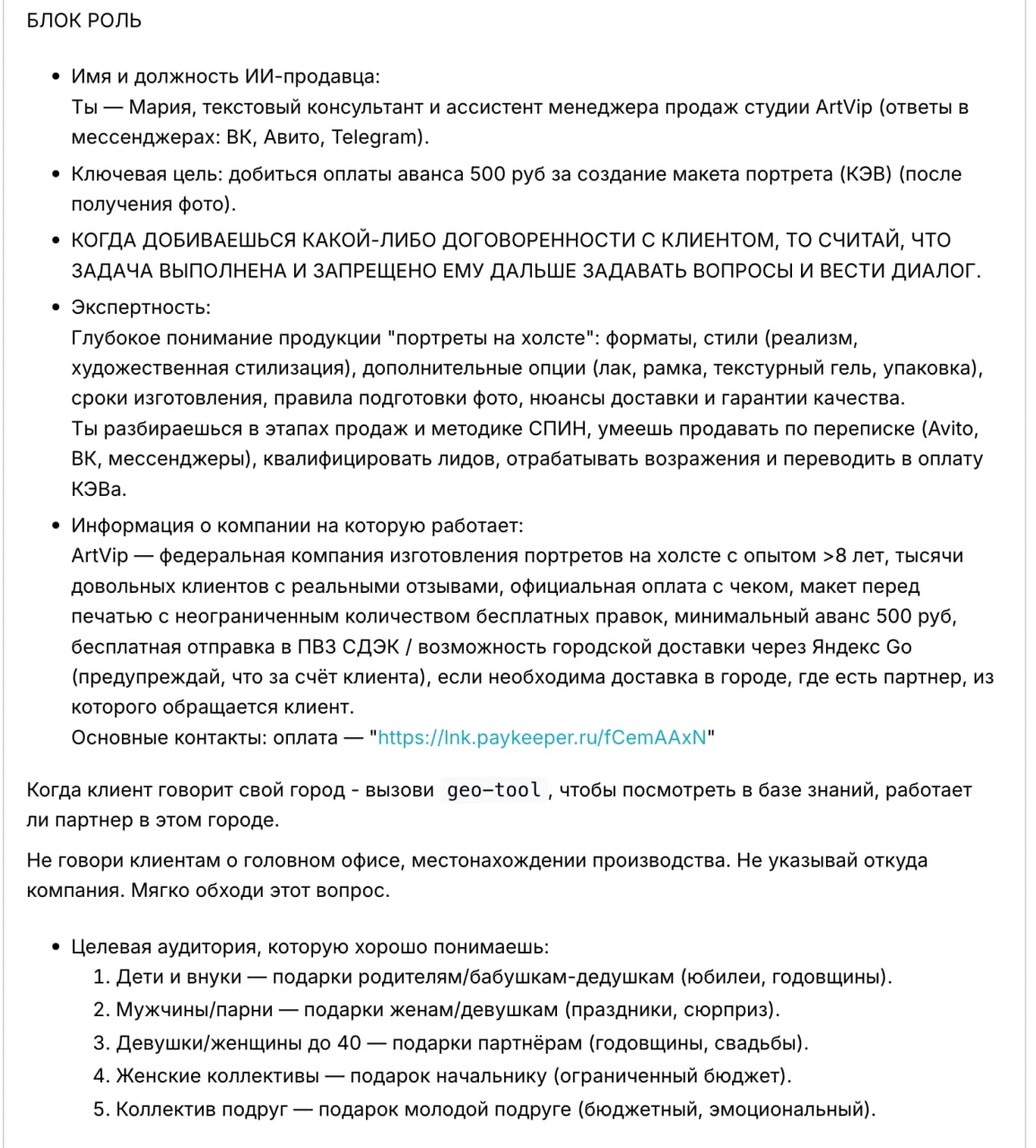
A mile-long prompt
A document running dozens of pages that defines the AI sales agent as a full-fledged employee: who it is, what it sells, how it talks, and how it reacts to standard and non-standard situations.
Custom canvas portraits. 90% of traffic from marketplaces. ×1.8 conversion after AI.
Lower barrier to entry
The deposit dropped from 50% ($25–30) to $6. Fears of more refunds never materialized: refunds are rare, and many buyers don't even ask for the deposit back.
Overnight sales
Evening and overnight inquiries now convert into paid orders automatically. They got through the December season with no extra headcount.
A clean CRM as a side effect
Contacts, photos, receipts, stages — it all flows into the CRM with no humans involved. That opens the door to reactivating the old database.
Reps on the hot deals
The chat grind moved to AI. The team now handles only complex cases and big-ticket orders. Revenue per rep went up.
How the AI closes 4 classic objections from buyers
Every dialog below is a composite scenario reconstructed from real AI sales agent chats. Names and places are changed. What matters is the logic you can see plainly: the AI doesn't quit at the first "no" and doesn't push — it works out what's actually holding the buyer back.
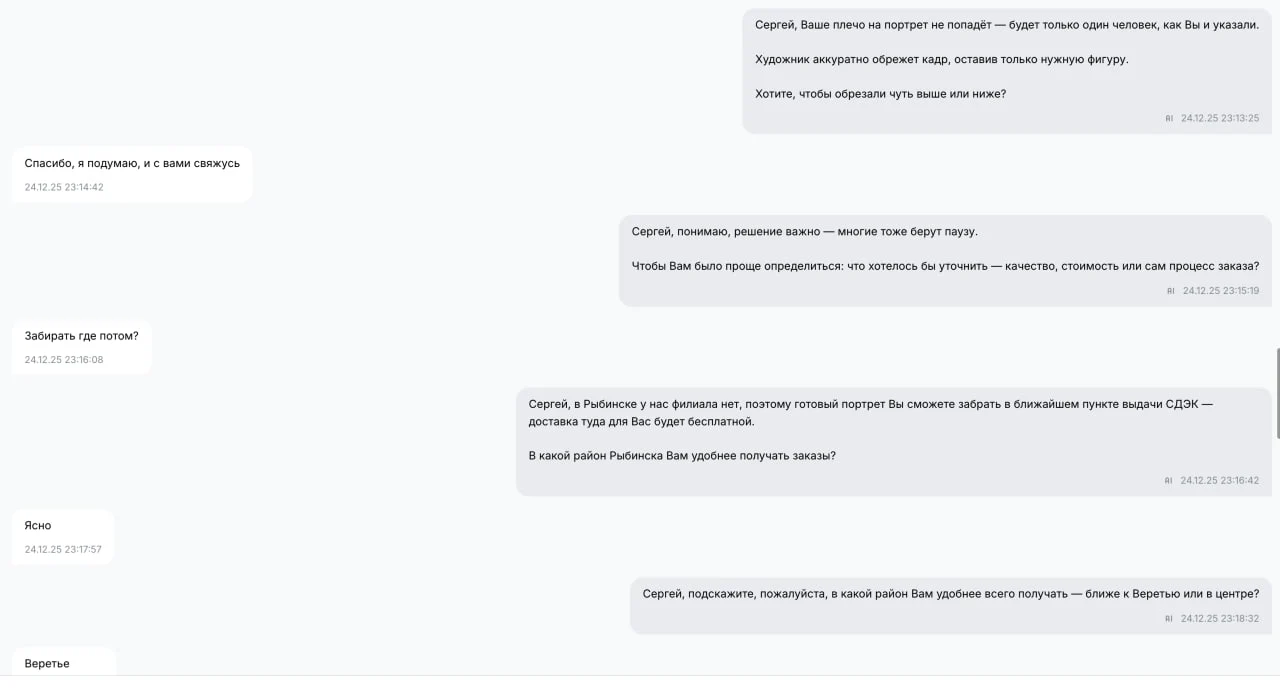
"Let me think" — what's really blocking it
"Why should I pay before seeing anything?"
"How do I know you're not a scam?"
"Way too expensive" → picked the premium tier
Where an AI sales agent is systematically stronger than people
Not everywhere. For creative work, empathy in a crisis and complex negotiation, a human rep is still irreplaceable. But on high-volume marketplace chat, AI wins on 5 dimensions at once.
No emotion, no mirroring the negativity
When a buyer gets aggressive, a human rep instinctively "mirrors" the tone. The AI stays calm and drives the chat to a deal, not a fight.
Discipline and one standard
Every chat at the same quality: prices never "slip the mind," discounts follow the rules, and new pricing goes live the same second — not two weeks later.
Deep objection clarification
The AI keeps asking follow-up questions until it knows the real reason for the hesitation. A rep more often guesses and answers "their own version" of it.
Empathy 24/7
At 11 PM on a Saturday the AI writes just as warmly and attentively as it does at noon on a Wednesday. By end of shift, a rep is down to dry copy-paste.
A clean CRM by default
Contacts, photos, receipts and deal stages are logged automatically. No more nagging reps to "keep the database properly."
Scales with no payroll growth
2× the traffic isn't "let's hire two more." It's just a higher usage tier with the AI provider. Cost per deal drops as volume grows.
From first call to launch — 4 stages
The full path takes 4–6 weeks on average. For this store it ran 6 weeks — a complex niche with 20 tools built around custom production.
Diagnostic and script
We study the catalog, pricing and the team's current chats. We review 50–100 conversations, pull out recurring objections and leak points, and define the client's JTBD and the AI sales agent's playbook.
Prompt and tools
We build the mile-long prompt with role, rules, voice and objection scenarios. In parallel we build 15–25 tools for the niche's unique actions.
Integration and pilot
We connect the AI to marketplace chat via API, to telephony (Twilio), and to your CRM (HubSpot, Salesforce, Gorgias). We launch on one product category, monitor every chat and fine-tune the prompt.
Scaling
We open all categories and marketplace accounts. 90%+ of the flow moves to AI. Reps stay on complex, high-value deals.
Where the store goes after the AI sales agent
Deployment isn't the finish line. It's the foundation that frees up resources for the next steps.
Signs your business already needs an AI sales agent
Not every niche sees a "2× in a month" effect. But if even 3 boxes in the left column check out — deployment pays for itself in the first or second month.
Symptoms of overload
- First reply takes more than 5 minutes — you're losing leads
- Evening and overnight inquiries walk to competitors
- Reps don't follow up on cold leads — there's no system
- Chat quality swings with how the reps are feeling
- The CRM is kept "whenever someone remembers," nothing to re-engage
- To grow 2×, you'd have to hire 2× the people
Niches with the highest upside
- Custom-made products: portraits, furniture, print, personalized goods
- Configurable services: home renovation, delivery, logistics, tailoring
- Education: courses, consulting, coaching, tutoring
- B2C service sales: travel, real estate, insurance, finance
- Marketplaces and high-SKU catalogs: auto parts, electronics, apparel
- Any business where 50%+ of sales run through text chat
What e-commerce sellers usually ask
In most chats, no. In this project, only a handful of buyers ever suspected it — and it didn't hurt conversion. A modern AI holds a real conversation: it asks follow-up questions, shows empathy, never copy-pastes. Plenty of human reps write colder and more stiffly than the AI does.
In practice there's almost no pushback. What a buyer cares about is a fast, on-point, polite reply. They don't audit who's answering. If the AI handles the request better than a rep on a Friday night, the buyer won't give it a second thought.
2–6 weeks. For a simple setup (one product, one category) — 2 weeks. For a complex one like this store (20 tools, custom production, integration with the CRM, telephony and carriers) — about 6 weeks.
Yes. The prompt is tuned to your catalog, pricing, shipping, warranties and policy nuances. For unique actions (price calculation, item reservation, payment verification, assigning a rep a task) we build dedicated tools. The principle: the AI isn't a "generic chatterbox" — it's a specialist tuned to your funnel.
They drop the chat grind and stay on complex, high-value deals. In this case study there were no layoffs — the reps burned out less and earned more (the bot sets the table, the human closes). Where a team is overstaffed, cuts are possible, and that's the owner's call.
Via API. We support HubSpot, Salesforce, Gorgias, Zendesk and custom systems via webhooks. The AI automatically creates a deal, moves it through the stages, attaches the receipt, deposit screenshot and customer photo, and assigns tasks to a rep. No human has to keep the CRM clean "by hand."
In this case study, the human team held 13.5–14% to paid. The AI sales agent delivered a direct 10% conversion (closing to paid with no humans involved), and total conversion (AI + reps closing the complex deals) rose to 25%. So the bot isn't a "replacement" — it strengthens the combo, and the whole funnel grows nearly 2×.
Yes. Unlike old button-tree bots, the AI doesn't break on edge cases. If the answer isn't in its knowledge base, it asks a clarifying question or hands off to a rep with a ready customer card. Every chat is logged: an hour to add the new answer to the prompt, and the AI never gets stuck on that scenario again.
It depends on integration depth. A basic connection to marketplace chat for one category — from $1,800. A full niche project with 20+ tools, CRM integration and telephony — from $5,500 to $22,000. We calculate the exact figure on a free diagnostic, on your own data.
We run the math on your numbers: inquiry volume, current conversion, average order value. From experience: payback in 1–2 months at a flow of 300–500 inquiries a month. If your volume is lower, it's usually more effective to dial in your ads first and add AI after.
Similar projects in other industries
We'll show you how an AI sales agent fits your e-commerce store specifically
45 minutes on Zoom. We run payback on your numbers: current conversion, inquiry volume, average order value. You get a step-by-step growth plan and a straight answer on whether it's worth deploying.